

Ownership is what the contract says it is. Practical control is contractual plus technical, and if you get either half wrong, you can legally own your data and still not be able to touch it when a vendor's servers go dark. Before you sign anything, negotiate four things:
- Explicit ownership wording naming your organisation as owner of customer data, not just a licensee of it.
- Usable portability, meaning a real export in a machine-readable format, delivered within a set number of days, not "on request, eventually."
- A ban on resale or AI training on your data without your specific, opt-in consent.
- Defined deletion terms with certification, so you get proof the vendor actually destroyed your data after termination, not just a promise.
A customer-friendly SaaS agreement states customer ownership, gives immediate access on demand, specifies an export format and timeline at termination, and provides deletion certification. Everything else in a SaaS contract is negotiable. These four points are not.
Key takeaways
Data ownership in SaaS is only as real as the export you can produce and the deletion certificate you can demand, both fixed by contract wording before signature, not after.
| Point | Details |
|---|---|
| Ownership needs enumeration | A clause naming customer data, provider materials, service data, and derived data separately beats a single vague ownership line. |
| Portability must be tested | Demand a sample export in a machine-readable format before signing, not just a promise at termination. |
| Derived data needs limits | Require opt-in consent before any aggregation, anonymisation, or AI training use of your data beyond service delivery. |
| Technical controls prove contract terms | Tenant-scoped audit logs and least-privilege access turn paper rights into enforceable ones. |
| Seventasks avoids data mining by design | Seventasks doesn't sell analytics or train AI on customer data, and supports open Excel import and export without lock-in. |
Table of Contents
- Data ownership in SaaS: what "ownership" and "control" actually mean
- Contract clauses to require or tighten before signing
- What due diligence to run before you sign anything
- Technical controls that make contract rights enforceable
- How to plan your exit before you need one
- What a vendor built around customer control looks like
- What the checklist approach gets right, and where it falls short
- Choose a platform that treats your data as yours from day one
- Sources
Data ownership in SaaS: what "ownership" and "control" actually mean
Most procurement teams treat "we own our data" as a settled question once it appears in a contract's opening paragraph. It isn't. SaaS data ownership splits into at least four legal categories, and how a vendor defines each one determines whether your ownership clause means anything in practice.
- Customer data is what your team enters, uploads, or generates while using the platform: tasks, files, messages, records.
- Provider materials cover the vendor's own software, templates, and underlying code, which they own regardless of what you put into it.
- Service or operational data includes logs, usage metrics, and system telemetry the platform generates as a byproduct of running your account.
- Derived, aggregated, or AI training data is anything the vendor extracts, anonymises, or feeds into a model built from your activity across the platform.
The trouble starts in category four. A vendor can hand you a clean ownership clause for category one and then bury a separate "product improvement" licence elsewhere in the same document, granting itself broad rights to aggregate, anonymise, or train models on the same data you thought you owned outright. That licence doesn't contradict the ownership clause on paper. It just makes the ownership clause commercially meaningless, because the economic value of your data (patterns, benchmarks, behavioural signals) has already been captured by someone else.
Here's what that looks like in practice. A weak clause might grant the vendor "a perpetual, worldwide licence to use, reproduce, and create derivative works from customer data for any business purpose." That's a blank cheque. A workable clause instead limits use strictly "for the purpose of providing and improving the service to this customer," and requires separate written consent before anything is aggregated with other customers' data or used to train a model. The difference between those two sentences can be worth real money if your data reveals pricing patterns, client lists, or operational benchmarks a competitor would pay to see.
A properly drafted data ownership clause maps each category explicitly, ties every permission to a stated purpose, and refuses to let "service data" or "aggregated insights" become a backdoor around the ownership language you fought to get in section one. If your vendor won't itemise categories this way, that reluctance is itself informative. Ask why.
Contract clauses to require or tighten before signing
Legal and procurement teams often treat SaaS contracts as a single negotiation point: "does the customer own the data, yes or no?" That question is too blunt. The real work is in six specific clauses, each doing a different job. Tighten these, and you've covered most of what actually matters for saas data ownership and data rights in SaaS more broadly.
Ownership clause. It should enumerate data categories by name (customer data, provider materials, service data, derived data) rather than using a single umbrella term, and it should confirm your organisation retains all intellectual property rights in customer data, with the vendor holding only a limited service licence.
Licence scope. The service-delivery licence needs to be narrow and purpose-bound. It should explicitly prohibit resale, third-party analytics sharing, and AI model training without your prior written consent. Silence on any of these is not neutral. Silence usually favours the vendor.
Portability and export. This clause should specify the exact export format (CSV, JSON, or a documented API schema), a defined delivery timeline (measured in business days, not "reasonable time"), and how often you can request a test export during the contract term, not just at termination.
Deletion and retention. Spell out how long backups persist after deletion, what "deletion" actually means technically (soft delete versus permanent purge), and require written certification of destruction once it's done.
Sub-processor transparency and breach notification. You need visibility into who else touches your data (hosting providers, analytics partners, support tooling) and a firm SLA for breach notification, ideally within 72 hours to align with common regulatory expectations under frameworks like the EU's data governance rules.
No withholding, plus transition assistance. The contract should explicitly bar the vendor from withholding data as leverage over an unresolved invoice dispute, and it should define what transition assistance looks like: hours included, deliverables, and any capped fees.
Pro Tip: Ask the vendor to walk you through their standard contract clause by clause on a call, live, before signing. Vendors who've genuinely built these protections into their process answer fast and specifically. Vendors who haven't will stall, generalise, or redirect you to "legal will follow up," which tells you everything about how that relationship goes after termination.
None of these clauses are exotic. They're standard asks in any mature SaaS negotiation. What's unusual is how rarely customers push for all six in a single sitting rather than accepting whichever three the vendor's boilerplate happens to include.
What due diligence to run before you sign anything
Contract language only matters if the underlying systems can actually deliver what the clause promises. That means running technical and documentary checks alongside the legal review, not after it.
- Request the SOC 2 or ISO 27001 report itself, not a marketing summary referencing it. Read the scope section and the exceptions noted by the auditor. A report with several unresolved exceptions from the prior cycle tells you more than the certification badge does.
- Ask for a data map and a sample export. A vendor that can produce a real export inside a sales call, rather than promising one "post contract," has clearly done this before.
- Inspect what's inside that export. Check the schema is documented, metadata (timestamps, user IDs, relational references between records) is intact, and nothing has been flattened into an unusable blob.
- Confirm backup frequency and recovery targets. Ask for the vendor's Recovery Time Objective and Recovery Point Objective in hours, and whether backups are stored in a geographically separate region.
- Ask what happens if the vendor goes under. A continuity plan that only covers outages and not insolvency isn't a continuity plan, it's half of one.
- Check the tenant isolation model and vendor staff access controls. Confirm least-privilege enforcement is real, not just a policy document, by asking how access requests by their own engineers are logged and approved.
SOC 2 and ISO 27001 reports, sample exports, and documented backup procedures are the standard proof points enterprise buyers request, and for good reason: they convert vendor claims into evidence you can actually check. Skipping this step because the sales cycle is moving fast is the single most common reason customers discover, mid-migration, that the export they were promised doesn't exist in a usable form.
Technical controls that make contract rights enforceable
A contract clause guaranteeing data control means nothing if the platform's engineering doesn't support it. This is where legal promises either become real or quietly evaporate.
- Role-based access control (RBAC) with least-privilege defaults, so users and vendor staff alike only see what their function requires, plus mandatory multi-factor authentication on every privileged account.
- Tenant-scoped, immutable audit logs that record every access event, including when the vendor's own developers touch your account, and cannot be edited after the fact.
- Customer-managed encryption keys or documented key separation, where your organisation controls or at least co-controls the keys that decrypt your data, rather than the vendor holding sole custody.
- Bulk export APIs with complete metadata, letting you validate a full export programmatically rather than trusting a manual data dump.
Effective governance in a multi-tenant SaaS environment is built at the data layer, with tenant-specific audit logs ensuring vendor engineers can't access customer records without leaving an auditable trail. If a vendor can't show you what that trail looks like, in a real screenshot, not a diagram, the "least privilege" language in their security page is aspirational rather than operational.
Tenant-scoped audit logs and customer-managed keys are what turn a paper right into an enforceable one. A vendor that supports both gives you something you can independently verify at any point in the relationship, not just at the moment of signing.
How to plan your exit before you need one
Exit planning has to happen before signature, not after you've decided to leave. Waiting until the relationship is already souring means negotiating from a position of weakness, with a vendor who now has less incentive to cooperate.
- Draft a detailed exit timetable during negotiation, with named acceptance criteria for what a successful export looks like, and actually test it once during the contract term, not just imagine testing it at termination.
- Decide when escrow is warranted. For business-critical platforms, a SaaS escrow arrangement holding source code, configuration, and a documented export procedure with a neutral third party gives you a fallback if the vendor becomes unresponsive or insolvent.
- Negotiate transition assistance terms up front: a defined number of support hours, specific deliverables, a fee cap, and a named contact point who isn't a generic support inbox.
- Run a dry-run migration into a staging environment before you need the real thing, checking schema integrity and confirming every relational reference survived the export intact.
Pro Tip: Put the exit test on your calendar the same week you sign. A test export scheduled for "sometime before renewal" never happens. One scheduled for a specific date, with someone accountable for running it, almost always does.
Negotiation wins tend to happen when legal, IT, and procurement run a joint export test before the contract is even finalised, because it turns an abstract promise into something you've already seen work.
What a vendor built around customer control looks like
Seventasks was built on the premise that you shouldn't need a lawyer to figure out whether you actually own your project data. The platform publishes its security and compliance posture openly, states plainly that it doesn't mine customer data or sell it into analytics products, and doesn't train AI models on what your team enters. Task lists, files, and messages stay yours, full stop.
For procurement teams evaluating any vendor, not only Seventasks, the useful move is to check whether these claims map to actual documents you can read before signing:
- Does the End User Service Agreement state ownership in plain terms, or hide it behind a broad service licence?
- Is Excel import and export genuinely open, letting you move data in and out without a support ticket?
- Does the pricing page disclose costs upfront, with no hidden tiers unlocking basic export functionality later?
Worth asking directly: what happens to your data the day you cancel, and can they show you, not tell you, how deletion certification works.
What the checklist approach gets right, and where it falls short
The conventional advice on SaaS data ownership treats it as a legal question, answered once, in a single clause. That framing undersells the problem. Ownership language matters, but it's only the first of two locks. The second is technical, and it's the one most negotiations skip entirely because lawyers don't ask engineering questions and engineers don't read contracts.
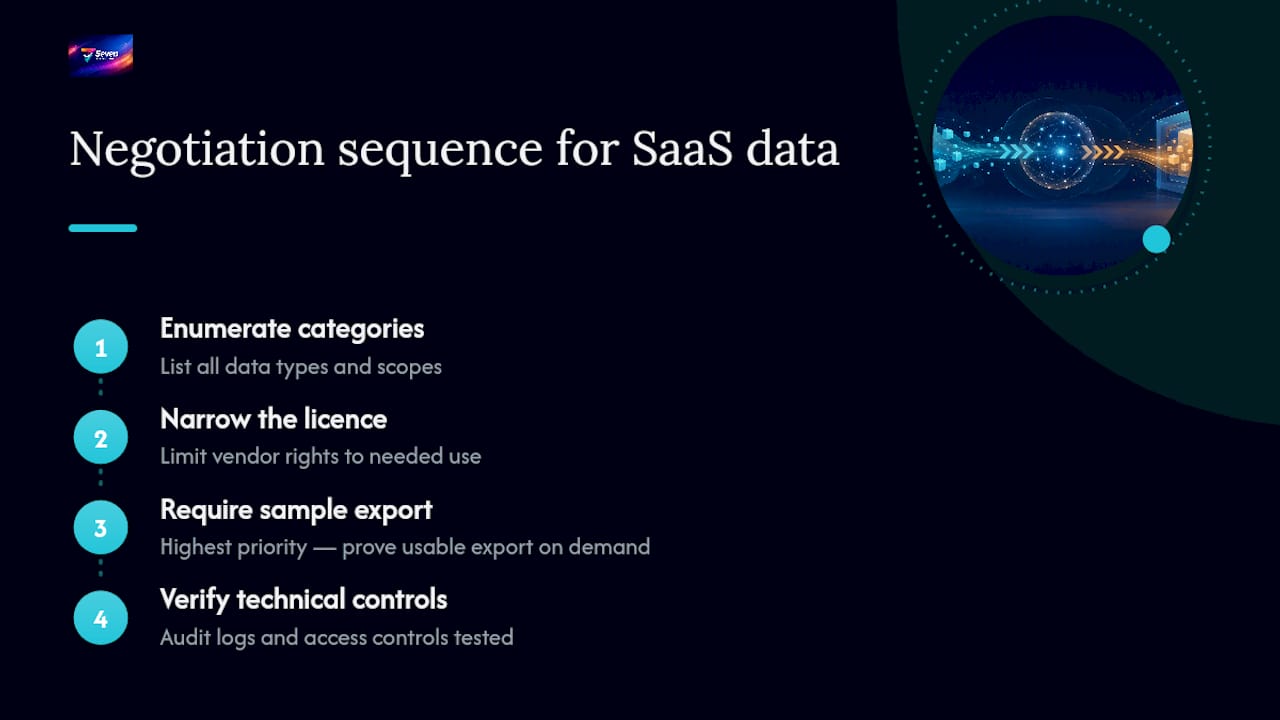
What the research actually supports is a negotiation sequence: enumerate categories, narrow the licence, demand a tested export, then verify with audit logs and access controls that the promises are real. Skip the technical verification step, and you've won a paper argument that won't help you the day a vendor's platform goes offline or a dispute turns adversarial.
If there's one priority above the rest, it's the sample export test. Everything else, ownership wording, deletion terms, escrow, is easier to negotiate once you've already proven the vendor can produce a usable export on demand. Vendors who resist that single request are telling you something worth hearing before you sign, not after.
— Greg
Choose a platform that treats your data as yours from day one
Plenty of project management platforms will tell you that you own your data. Fewer will show you, in the product itself, what that actually means. Seventasks was built by an independent team with a specific rule: no data mining, no analytics resale, no training AI models on what your team enters. Your tasks, files, and messages stay exactly where you put them, and you can pull them back out through open Excel import and export whenever you choose, with no lock-in mechanism designed to make leaving painful.
If you're comparing vendors against the checklist in this article, start by checking Seventasks's own security and compliance details against the questions raised above. Pricing is transparent too, with affordable options for individuals and teams, plus a free trial period to test against your own export criteria. Head to the Seventasks pricing page and run your own sample export before committing to anything longer term.
Sources
For legal teams drafting or negotiating these clauses, and IT teams validating vendor claims, these are the highest-value sources to keep close:
- SaaS Data Ownership: What Happens to Your Data When Your Vendor Goes Dark — Turley Law
- Data ownership clause: A practical SaaS contract checklist — ClearContract